

Missing Layer in India's Electronics Dream
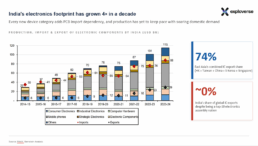
Every smartphone, laptop, television, automobile, defence system, or industrial machine runs on a hidden foundation most consumers never notice: the printed circuit board, or PCB. Often called the ‘backbone’ of electronics, a PCB is the platform that connects and powers all electronic components inside a device and helps semiconductors, sensors, memory chips, and processors communicate with each other. Yet despite India emerging as a major electronics assembly hub, the country remains heavily dependent on imports for PCBs, especially advanced multilayer boards used in smartphones, servers, telecom equipment, and automobiles. Much of this supply today comes from countries like China, Taiwan, South Korea, and Vietnam. This creates a major gap in India’s electronics manufacturing ambitions, where final products may increasingly be assembled locally, but a large share of the core electronic backbone is still imported. And the day that exporting nation decides to use this dependence as a strategic lever, whether through export restrictions, trade disputes, or supply disruptions, India’s electronics value chain could face significant vulnerabilities. Building domestic PCB manufacturing capabilities is therefore not just an economic opportunity, but increasingly a matter of supply chain resilience and strategic autonomy. What makes this more interesting is that India was not always so dependent. In the 1980s, the country had a growing domestic PCB manufacturing ecosystem supported by government policies, public sector demand, and an early push toward electronics self-reliance. So how did India move from having indigenous PCB manufacturing capabilities to becoming deeply import dependent today? In today’s blog, we will trace this journey and understand the key policy decisions, global shifts, and missed opportunities that shaped India’s PCB industry over the last four decades. Bharat Electronics Limited established its PCB manufacturing facility as early as 1968, and throughout the 1980s it served the bulk of defence, radar, and government electronics demand with captive in-house production. ITI (Indian Telephone Industries) and ECIL similarly fabricated boards for their own verticals: the telephone exchanges, the CDOT digital switches, the Doordarshan transmitter rollout. By the late 1980s, Sulakshana Circuits (1988), Garg Electronics (1989), and a wave of small-scale units seeded by the government’s MTB scheme had joined them, collectively covering single-sided and double-sided board requirements for the booming TV assembly and early PC manufacturing sectors. While domestic manufacturers were already capable of producing double-sided PCBs locally, they still depended on imports for key raw materials such as copper-coated glass epoxy sheets, as India lacked domestic production of sheets with the required 17.5-micron copper thickness. This implied India’s PCB dependency was concentrated more on the upstream side of the value chain. However, India’s challenges in electronics manufacturing extended beyond raw material dependence. Even in segments where domestic production capabilities existed, manufacturers often struggled to achieve globally competitive economics. A case in point was the country’s early integrated circuit (IC) industry. As shown in the table below, production of SSI/MSI integrated circuits increased more than twenty-fold between FY1976 and FY1988, rising from 0.19 million units to over 4.1 Mn units. Yet for most of this period, the industry remained loss-making despite the growth in output.How it Started?
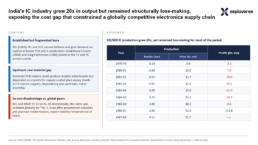
BEL sold its ICs for B&W TVs for Rs. 10 in India, while internationally they are available for about Rs. 5. Even when all government incentives and subsidies are taken into account, and their plant’s modernization realized, the export market will still not be profitable. (source)
Together, these constraints prevented India from building a globally competitive electronics supply chain despite having established capabilities across several parts of the value chain.
Rising Complexity, Rising Dependence
By the 2000s, that equation had quietly but completely reversed. India was no longer importing raw materials to manufacture PCBs locally. Instead, it had begun importing finished boards, and increasingly, fully assembled printed circuit board assemblies (PCBAs) with all components already mounted on them. The reason was simple: India’s rapidly modernising economy had become far more sophisticated than what its surviving PCB manufacturers were capable of producing.
The shift was triggered by the explosion of new electronics categories through the 1990s and 2000s. India’s first mobile phone call was made on July 31, 1995, and companies like Nokia, Motorola, and Ericsson soon entered the market. Alongside mobile phones came personal computers, telecom switching equipment, cable set-top boxes, and other electronic devices that required significantly more advanced circuit boards than the single-sided and double-sided PCBs commonly produced in India during the 1980s.
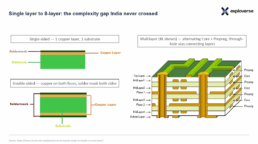
A mid-1990s feature phone typically required a 4-to-6-layer PCB with fine-pitch surface mount components. Desktop computer motherboards evolved toward 6-to-8-layer boards with controlled impedance routing.
By the 2000s, even a Nokia handset required sophisticated boards featuring blind and buried vias, technologies that demanded laser drilling and advanced fabrication capabilities unavailable in India. As component density increased and chip packaging became more compact, the industry rapidly transitioned towards multilayer PCBs capable of stacking multiple interconnected circuits within a single board. India, having never meaningfully invested in this next generation of fabrication capabilities, found itself increasingly unable to keep pace with global technological requirements.
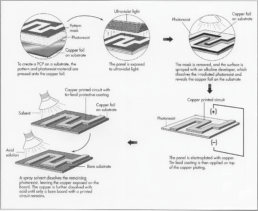
So, instead of building domestic fabrication capacity, Indian assemblers and global electronics brands found it easier and significantly cheaper to import finished PCBAs directly from countries such as China, Taiwan, South Korea, and later Vietnam. Government policies unintentionally accelerated this shift.
> Zero-duty imports on components and sub-assemblies for high-growth products like mobile phones, PoS machines, micro-ATMs, and set-top boxes reduced the incentive to manufacture components locally.
> Duty-free imports of PCBAs directly weakened demand for domestically manufactured PCBs and discouraged fresh investment into the segment.
In an effort to make electronics more affordable and scale assembly-led manufacturing, India created an ecosystem where importing a completed board from East Asia was structurally cheaper and easier than building the deep manufacturing infrastructure required to produce one domestically.
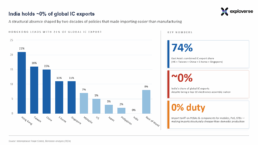
India’s PCB industry largely remained stuck at the single-sided and double-sided board stage, while the rest of the world moved rapidly towards advanced multilayer, high-density, and precision-engineered PCBs required for modern electronics. As a result, when products like the iPhone are manufactured in India today, there is often little choice but to import the sophisticated PCBAs and critical electronic sub-assemblies from global supply chains dominated by East Asia.
More Devices, More Boards: Why Electronics Dependence Only Deepens
To understand why India’s PCB import problem is structurally worsening rather than simply persisting, one must first reckon with how completely electronics have colonised daily Indian life over the past three decades. In 1990, a typical Indian household might have owned a television, a transistor radio, and perhaps a landline telephone. That was largely the extent of it. Electronics was a category most Indians encountered, not one they lived inside.
Today, the same household is likely to own multiple smartphones, a flat-screen television, a washing machine with a digital control board, an inverter air conditioner, a WiFi router, and a two-wheeler or car whose engine management system, ABS, and instrument cluster are all electronically governed. Each of these products contains at least one PCB. Many contain several.
The average middle-class Indian household in 2024 likely carries more circuit board area within its walls than an entire small factory floor would have in 1985.
In 1999, just 7% of Indian households owned a landline phone; by 2005, that figure had peaked at 14%. Today, less than 1% of homes have a landline phone, but mobile phone ownership has exploded, democratising telephony in a way landlines never could. In 2008, India had 346 million registered mobile SIM cards; between 2008 and 2024, that number more than tripled. Every one of those handsets, whether a feature phone or a smartphone, carries a PCB inside it. The shift from feature phones to smartphones alone multiplied PCB complexity per device by an order of magnitude: a flagship smartphone PCB today can have 12 to 16 layers, compared with the 4 to 6 layers of a mid-2000s Nokia handset. More users, and more circuit board content per user: both variables have moved simultaneously and sharply upward.
A Maruti 800 of the 1990s had a carburettor, a simple ignition system, and almost no electronic governance, perhaps one or two rudimentary control modules. A mid-segment passenger car sold in India today is a fundamentally different machine. Modern cars incorporate between 30 and 100 Electronic Control Units (ECUs) that manage powertrain, infotainment, safety, and autonomous driving functions, and each ECU is anchored by a PCB. EVs require an average of 95 ECUs per vehicle, compared with around 70 in traditional internal combustion engine vehicles, as battery management, thermal regulation, and power conversion introduce entirely new electronic systems.
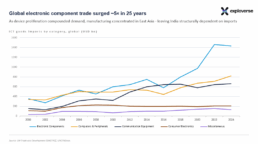
Therefore, global trade in electronic components, including chips, circuit boards, and sensors, has surged nearly fivefold over the last 25 years. At the same time, manufacturing has become increasingly concentrated in a handful of countries, leaving much of the world, including India, dependent on imports for these critical components.
Breaking the Dependency: What India's PCB Policy Must Get Right
India’s PCB dependence is not the result of a single policy mistake, nor can it be solved through a single subsidy scheme. The industry’s weakness today reflects decades of underinvestment across the entire value chain, from raw materials and fabrication technology to ecosystem development and skilled manpower. If India is serious about building a globally competitive PCB industry, the policy response must address the structural bottlenecks that have prevented domestic manufacturing from scaling in the first place.
Five areas, in particular, stand out.
Fix the Raw Material Bottleneck: About 90% of the copper-clad laminates (CCLs) and specialty chemicals used by India’s PCB industry are still imported, predominantly from China, Taiwan, and South Korea. This dependence on imported CCLs, the single most important input in PCB manufacturing, remains the industry’s biggest structural disadvantage.
A Chinese PCB manufacturer sources laminates domestically at scale, benefiting from lower costs, shorter lead times, and a tightly integrated supply chain. An Indian manufacturer often buys the same material from the same origin, but at a premium, with longer lead times and additional currency risk.
The result is a cost disadvantage that exists before a single board is produced. No amount of downstream manufacturing incentives can fully bridge this gap without first addressing the upstream input layer.
Use Government Procurement to Create Demand: India's defence sector, railways, public-sector telecom infrastructure, and government electronics programmes collectively consume billions of dollars worth of PCBs every year. A clear policy requiring that government-procured electronics above a certain threshold value incorporate domestically manufactured PCBs, with a defined phase-in schedule, would create the anchor demand that Indian fabs need to justify large-scale capital investment. Building an HDI PCB facility requires significant upfront capital and a multi-year payback period. Without predictable long-term orders, few private investors will be willing to commit capital to such projects. Government procurement can therefore play a critical role in creating the initial scale required for the industry to become commercially viable.
Building Clusters is Key: A PCB factory without a surrounding ecosystem is not a competitive PCB factory. It is an import-dependent assembly point with extra steps. What made Shenzhen and the Pearl River Delta the world's PCB centre was not a single factory, but the co-location of CCL suppliers, chemical vendors, equipment maintenance companies, laser-drilling specialists, trained process engineers, logistics infrastructure, and environmental treatment facilities, all within a radius where proximity reduces costs and turnaround times.
Build the Talent Pipeline: India's PCB industry suffers from a severe talent gap at almost every level: PCB design engineers who understand HDI and high-frequency board constraints, process engineers who can manage sequential lamination and laser-via drilling, quality professionals certified to IPC-6012 and IPC-A-600, and chemists who understand the plating-bath chemistry that separates a reliable board from a defective one. China attracted foreign capital and manufacturers, which brought both technology and talent, enabling the transfer of knowledge and expertise to the domestic ecosystem. India will have to adopt a similar approach, tailored to its own strengths and circumstances.
Develop a Domestic Capital Goods & Advanced Materials Ecosystem: Critical machinery used in PCB fabrication is predominantly imported, particularly from China, while key components such as precision drills, plating chemicals, and manufacturing consumables continue to be sourced externally. These dependencies increase costs, elongate supply chains, and expose the industry to geopolitical and trade-related disruptions. Building domestic capabilities across equipment manufacturing, specialty chemicals, consumables, and process technologies will be essential to creating a resilient and globally competitive PCB ecosystem.
New Oil of the Digital Economy
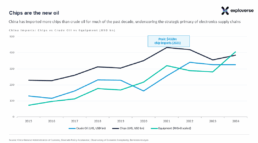
If oil powered the industrial economy of the 20th century, chips and electronic components are powering the digital economy of the 21st. As the chart shows, China has spent more on importing chips than crude oil for much of the past decade, showcasing the growing strategic importance of electronics supply chains.
The broader lesson from every country that successfully built a PCB industry, whether Taiwan, South Korea, Japan, or, eventually, China, is that the journey took fifteen to twenty years of sustained, sequenced, and occasionally uncomfortable policy commitment. A strategic joint-venture framework, coupled with a clear ten-year PCB Vision Roadmap, can accelerate India’s integration into the global value chain, but only if that roadmap is treated as a binding national industrial commitment rather than a ministry presentation.
India assembled its way to becoming the world’s second-largest smartphone manufacturer without making a single PCB for those phones. The next chapter requires doing what is actually harder: building the manufacturing foundation that makes final assembly truly meaningful.


Quantum Computing: Leapfrogging to The Future
In 2023, IBM introduced its 433-qubit Osprey processor, while Google’s Sycamore demonstrated quantum supremacy by completing a calculation in just 200 seconds—something that would take the fastest classical supercomputers over 10,000 years. These breakthroughs are not just milestones; they signal a monumental leap from theory to reality. Quantum computing is here, and it’s set to revolutionize artificial intelligence and reshape entire industries. The concept of quantum computing emerged in the early 1980s when physicist Richard Feynman proposed harnessing quantum mechanical phenomena for computation. His insight came from the difficulty of simulating quantum systems using classical computers. Shortly after, David Deutsch described the first theoretical quantum computer, introducing the world to the possibility of solving complex problems exponentially faster than classical computers. However it was in 1994 that MIT mathematician Peter Shor published one of the first practical real-world applications for a quantum machine. His algorithm for integer factorization showed how a quantum mechanical computer could potentially break the most advanced cryptography systems of the time—some of which are still used today. Shor’s findings demonstrated a viable application for quantum systems, with profound implications for fields beyond just cybersecurity. Quantum computing leverages the fascinating principles of quantum mechanics – the branch of physics that deals with the behaviour of subatomic particles. – electrons, photons, quarks, neutrinos and more. Now, photons are quantum particles that make up light. Experiments by scientists in the early 20th century showed how a photon with high enough frequency can knock an electron free from the surface of a metal. Another way to understand this is that just trying to get a better look at a subatomic particle would change the momentum of the electron. This emerging technology spans multiple scientific domains, including the development of quantum hardware and the creation of specialized quantum algorithms. Though the field is still maturing, quantum computers promise to tackle computational challenges that lie far beyond the reach of even our most advanced classical supercomputers. Quantum computers harness the counterintuitive behaviors of subatomic particles to perform certain types of calculations with unprecedented efficiency. While classical computers use binary bits – zeros and ones – to store and process data, quantum computers leverage quantum bits or qubits, which can hold far more information due to their ability to exist in superposition (the ability to exist in multiple states at once). This essentially means that while a binary bit holds a fixed value (0 or 1), a qubit can be both 0 and 1 at the same time. This is the strange and nearly inexplicable behaviour of quantum mechanics that this QC harnesses. Quantum computing enhances AI by accelerating data processing and model training. Several specific advantages include:
Conversely AI plays a key role in the development and optimization of quantum systems:
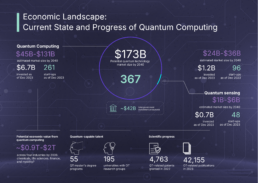
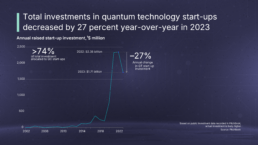
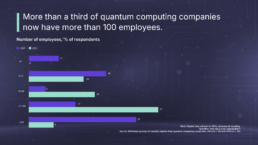
Quantum Computing has recently reached a crucial milestone with IBM aiming for a 4,000+ qubit system by 2025. Meanwhile, governments worldwide are investing heavily in quantum research, recognizing its potential impact on national security and technological advancement. China has reportedly invested $10 billion in a national quantum laboratory, while the US has committed $1.2 billion to the National Quantum Initiative. Though a fully functional, error-corrected quantum computer remains years away, the progress in recent years suggests we’re moving steadily toward this revolutionary technology. In 2023, private and corporate investments in quantum technology (QT)* start-ups experienced a 27% decline, totaling $1.71 billion, down from $2.35 billion in 2022. This decrease was less severe than the 38% drop observed across all global start-up investments during the same period. Notably, 62% of the QT funding was directed toward companies established five or more years ago, indicating a strategic focus on scaling mature start-ups. In contrast, public investments in QT surged by over 50% in 2023, accounting for nearly a third of all QT investments. Countries such as Germany, the United Kingdom, and South Korea announced substantial new funding, bringing total global public investment to approximately $42 billion. The quantum computing (QC) industry is undergoing rapid growth, as reflected in a recent McKinsey survey of industry leaders. The survey highlights a shift in the size and scale of companies in the sector: firms with fewer than six employees have increased from 0% to 11%, while those with over 100 employees have risen from 9% to 39%. This indicates both the emergence of new players and the scaling up of established companies, signaling progress toward fault-tolerant quantum computing (FTQC). Fault-tolerant QC refers to a system capable of performing quantum computations reliably, even in the presence of errors. Unlike today’s noisy intermediate-scale quantum (NISQ) systems, FTQC would use error-corrected qubits to process information more accurately and execute long computations without failure. Over 65% of surveyed experts expect FTQC to be achieved by 2030, though debates persist regarding whether “true” fault tolerance requires large-scale logical qubits or whether high-error tolerance with minimal correction suffices for useful applications. Progress toward FTQC is evident in the rise of practical QC use cases, with 55% of respondents now having an in-production use case, up from 33% the prior year. Sectors like aerospace, automotive, oil and gas, and medical technology are among the early adopters likely to benefit from these advancements. In India, the government has taken significant steps to bolster the quantum technology sector. The National Quantum Mission, approved by the Union Cabinet with a budget of ₹6,003.65 crore (approximately $730 million) for 2023–2031, aims to advance quantum technologies in alignment with national initiatives like Digital India and Make in India. This mission focuses on developing quantum computing, communication, sensing, and materials, with the establishment of Thematic Hubs (T-Hubs) at premier institutions such as the Indian Institute of Science (IISc) Bengaluru and various Indian Institutes of Technology (IITs). These efforts underscore India’s commitment to scaling established start-ups and fostering innovation in the quantum technology landscape. Quantum computers can perform certain calculations exponentially faster than classical computers. This capability becomes particularly crucial for problems like cryptography, drug discovery, climate modeling, and optimization challenges that are practically impossible for traditional computers to solve. This makes quantum computing the potential key to breakthroughs in a number of critical industries.
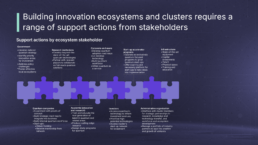
Technological: The primary challenge in quantum computing lies in maintaining quantum coherence – keeping qubits in their quantum state long enough to perform calculations. Environmental factors like temperature, electromagnetic radiation, and physical vibrations can cause “decoherence,” destroying the quantum properties essential for computation. Engineers must also tackle the challenge of scaling up quantum systems while maintaining precise control over individual qubits. Error correction remains another significant hurdle, as quantum systems are inherently prone to errors that must be detected and corrected without disturbing the quantum state. Scalability: Challenges persist, including limited access to advanced hardware, low awareness of QT applications, and inadequate interdisciplinary collaboration between academia and industry. To overcome these hurdles, coordinated innovation clusters are emerging globally. These partnerships between researchers, industry leaders, and governments aim to advance QT development, manage intellectual property, and drive regional technological value creation. A sustainable quantum ecosystem depends on three pillars: talent development, effective collaboration, and realistic expectations. Talent Development Talent development in quantum computing saw significant progress in 2023, with 367,000 graduates earning QT-relevant degrees. The number of universities offering QT programs grew by 8.3% to 195, and those offering master’s degrees increased by 10% to 55. The European Union and the United Kingdom lead in graduate numbers and density, respectively. Collaboration Models Managing Expectations Focusing on these priorities will create an ecosystem capable of supporting QC’s long-term growth and delivering transformative technologies. Quantum computing stands at a pivotal moment in its evolution. While companies have achieved significant milestones, the industry is moving from experimental phases toward practical applications with India throwing its hat in the ring through its National Quantum Mission. With talent in the field only set to grow further, experts are more than hopeful that fault-tolerant quantum computing will be achieved by 2030, which would mark a revolutionary breakthrough. While challenges persist, the increasing number of practical use cases across industries and the growing ecosystem of researchers, industries, and governments suggest we’re steadily advancing toward a quantum-enabled future.The Birth of Quantum Computing
But wait! What is Quantum Computing?
Bringing the Quantum Edge to AI
AI for Quantum Computing
Economic Landscape: Current State and Progress of Quantum Computing
The Investment Scenario: Private v/s Public

QC Players Scaling Up

India and the Quantum Race
Use-cases for Quantum Computing
Challenges
Building a Sustainable Quantum Ecosystem
Building a skilled workforce requires expanding the talent pipeline beyond traditional physics PhDs. Programs introducing quantum concepts at earlier educational stages can prepare students for the unique challenges of QC.Quantum Talent on the Rise
Strong partnerships among academia, industry, and governments are essential for advancing QC. Reducing bureaucratic barriers, fostering open-source tools, and securing venture capital will drive innovation and enable practical applications.
Clear communication about the current state and future potential of QC is crucial to avoid disillusionment. Transparent updates and realistic goal-setting will maintain trust and ensure that stakeholders remain engaged in advancing the field.